Burrier–Culver family and federal fire-service history
David Monroe Burrier
Born about 1911–1912 · died 15 March 1984
Strong historical reconstructionA civilian fire officer who led Fort Belvoir’s department for twenty-five years, directed crash-rescue readiness at Davison Army Airfield, and put the rescue of people before the protection of equipment.
Biography
Rescue people first
A municipal fire marshal became the civilian chief of a major Army installation, led an airfield rescue service, survived a near-fatal explosion, and left one unusually clear statement of professional purpose.
At Davison Army Airfield, David Monroe Burrier trained three-person teams to move through burning aviation fuel toward an old aircraft fuselage and pull a training dummy free before they fully turned to the flames. The reported standard was seventeen seconds. His principle was simpler: “We want to rescue people first.”
Birth and death
Born in Baltimore about 1911–1912; died 15 March 1984 at Mount Vernon HospitalFort Belvoir service
Assistant fire chief from 1941; fire chief from 1944 until retirement in 1969Public-service status
Civilian fire chief at a United States Army installationSpecialized work
Fire prevention, wartime unit training, aircraft crash rescue, and installation safetyInternational work
His obituary reported a role establishing a firefighting program in Taiwan in 1958Known family
Wife Gladys and three children; later living generations withheldThis edition was checked against the David Monroe Burrier Illustrated Family-History Dossier, its underlying newspaper and Army sources, and the private family proof summary. The exact birth date, Taiwan assignment details, liquid-oxygen project, second rescuer, award files, and Gladys name discrepancy retain separate grades instead of borrowing certainty from the documented Davison record.
About 1911–1936
A Baltimore beginning and a move toward Washington
David was born in Baltimore about 1911–1912. The range is calculated from the age reported when he died; no exact birth record has yet established a day or selected one of those two years.
His 1984 obituary reported that he moved to the Washington area in 1936. The present evidence does not recover a childhood address, school, or the exact community in which he first settled, so the page begins with the regional facts the source actually supplies.
Approximately 1936–1939
Prevention before command
Before entering federal service, David served roughly three years as fire marshal with the Cheverly–Tuxedo Fire Department. The role placed prevention—inspection, code awareness, and reduction of risk—before the moment when an engine had to respond.
The obituary establishes the role and approximate duration but not exact appointment and departure dates. No individual municipal fire or inspection should be attached to David until a departmental record does so.
1941–1945
War comes to Fort Belvoir
David joined Fort Belvoir as assistant fire chief in 1941 and became chief in 1944. His obituary also credited him with helping train firefighting units for overseas duty, placing his work inside the Army’s larger wartime need for trained installation crews.
Fort Belvoir expanded rapidly during this period. A 1941 Library of Congress photograph can document the post’s wartime setting, but no person in that image is identified as David and the installation’s wider history cannot be converted into a list of his personal actions.
1944–1969
Twenty-five years as chief
David’s twenty-five years as chief carried the department from wartime operations through the changing aviation, fuel, medical-evacuation, and hazardous-material demands of the Cold War period. His title was civilian fire chief at an Army installation—not an Air Force rank and not proof of uniformed military service.
The long tenure matters because the hazards changed around him. By the end of his career, the clearest surviving source places his department inside an airfield system where crews had to understand aircraft fuel lines, batteries, electrical connections, exits, structural fires, and mutual aid beyond the post.
1958
A firefighting program in Taiwan
David’s obituary states that he helped establish a firefighting program in Taiwan in 1958. That brief sentence is significant: it places his expertise beyond Fort Belvoir and suggests that the Army trusted him to help translate training and command practice into another institutional setting.
The source does not say whether David traveled, how long the work lasted, which Taiwanese organization received the program, or whether it concerned an airfield, installation, municipality, or industrial site. This edition tells only what the obituary can carry and leaves every operational detail open.
Before 23 February 1962
When the rescuers saved the chief
A Northern Virginia Sun award item reported that an explosion during experimental work involving liquid oxygen injured David and severed a major artery in his leg. Arthur M. Pettit, although himself in shock, and a second firefighter stopped the bleeding.
The article identifies the medical danger and Pettit’s action but not the accident date, the second rescuer, the project, the test location, the hospital, or David’s recovery. A later unit-history clue involving Redstone missile liquid oxygen remains only a research lead; no evidence presently connects that program to this accident.
Documented in January 1970
Crash rescue at Davison Army Airfield
Army Digest described seven firefighters on twenty-four-hour duty at Davison, a continuous lookout scanning the runways, and more than 8,000 flights in an average month. Crews could be moving before the full emergency code finished sounding.
The firefighters trained on aircraft systems, supported medical-evacuation flights, inspected buildings and extinguishers, answered structural fires, and worked with nearby Fairfax County departments. During live-fire drills, three-man teams advanced through burning aviation fuel and oil to remove a dummy before completing suppression.
David’s seven-word summary—“We want to rescue people first”—is the clearest surviving expression of the department’s priority. The article identifies and quotes him, but its photographs do not identify David as one of the men shown.
1969–1984
Recognition, community, and the record left behind
David retired in 1969 after twenty-five years as chief. His obituary reported more than 200 commendations, fourteen fire-prevention awards from the International Fire Protectors’ Association, and two Department of Defense Meritorious Service Medals. Those are documented obituary claims; the certificates and official award files have not yet been located.
The same obituary placed him in the Moose, Odd Fellows, Elks, Lions, and Wesley Methodist Church in Alexandria. It named his wife as “Gladys B. Burrier,” while later family records identify her as Gladys Vida (Culver) Burrier. The later identification is strong, but an original marriage record is still desirable.
David died of pneumonia at Mount Vernon Hospital on 15 March 1984, aged seventy-two. The public archive ends with the historical record and leaves the living generations that descend from this family outside the page.
Chronology
A career carried from prevention into crash rescue
The surviving record fixes the major milestones while keeping the approximate birth year, Taiwan details, accident date, and award documentation at their proper levels.
- c. 1911–1912
Born in Baltimore
The year range is derived from the age reported at David’s death; an exact birth record remains open.
- 1936
Moved to the Washington area
The move is reported in David’s 1984 obituary; no private address is published.
- c. 1936–1939
Cheverly–Tuxedo fire marshal
Served roughly three years in municipal fire prevention before entering federal service.
- 1941
Joined Fort Belvoir as assistant fire chief
Entered the post fire department during Fort Belvoir’s wartime expansion.
- 1944
Became Fort Belvoir fire chief
Began the twenty-five-year chief’s tenure reported in his obituary.
- World War II era
Helped train firefighting units for overseas duty
The obituary records the work but does not identify the units or destinations.
- 1958
Helped establish a firefighting program in Taiwan
The country and year are reported; the organization, site, duration, and scope remain unresolved.
- Before 23 Feb 1962
Seriously injured in a liquid-oxygen explosion
Arthur M. Pettit and a second, unnamed firefighter controlled the bleeding from a severed artery.
- 1969
Retired after twenty-five years as chief
Ended a Fort Belvoir career that had begun as assistant chief in 1941.
- Jan 1970
Army Digest published the Davison rescue feature
The article named and quoted Chief Burrier while documenting the airfield operation and live-fire drill.
- 15 Mar 1984
Died at Mount Vernon Hospital
David died of pneumonia at age seventy-two.
Research stories
Four moments that reveal the work
Wartime training, an overseas program, a dangerous experiment, and a seventeen-second rescue drill show the range of the fire service David helped lead.
World War II era
Training fire units for duty overseas
The obituary places David inside the Army’s wartime effort to prepare firefighting units for service beyond Fort Belvoir.
- He joined as assistant chief in 1941 and became chief in 1944.
- No located source yet names the units, training syllabus, or overseas destinations.
- The installation’s broader wartime mission supplies context, not proof that David directed every related activity.
1958
A program in Taiwan, briefly recorded
One obituary sentence preserves an international contribution large enough to matter and too incomplete to embellish.
- The source says David helped establish a firefighting program in Taiwan.
- It does not identify the recipient organization or exact location.
- Travel, duration, curriculum, program type, and institutional outcome remain open research targets.
Before February 1962
A liquid-oxygen explosion and two rescuers
An explosion severed a major artery in David’s leg; Arthur M. Pettit and another firefighter stopped the blood loss.
- The newspaper published Pettit’s award notice on 23 February 1962.
- The second firefighter is unnamed in the searchable text available to the dossier.
- A Redstone missile connection is plausible context only and is not presented as the answer.
Published January 1970
Seventeen seconds through burning fuel
Davison crews practiced reaching and removing a casualty before turning fully to fire suppression.
- Three-person teams advanced through burning aviation fuel and oil toward an old fuselage.
- Army Digest reported a seventeen-second training performance.
- The article names and quotes David but does not identify him in the photographs.
Contemporary article · DB-001
“Code Seven”—Fire-Fighters to the Rescue
Army Digest · January 1970 · pages 54–55
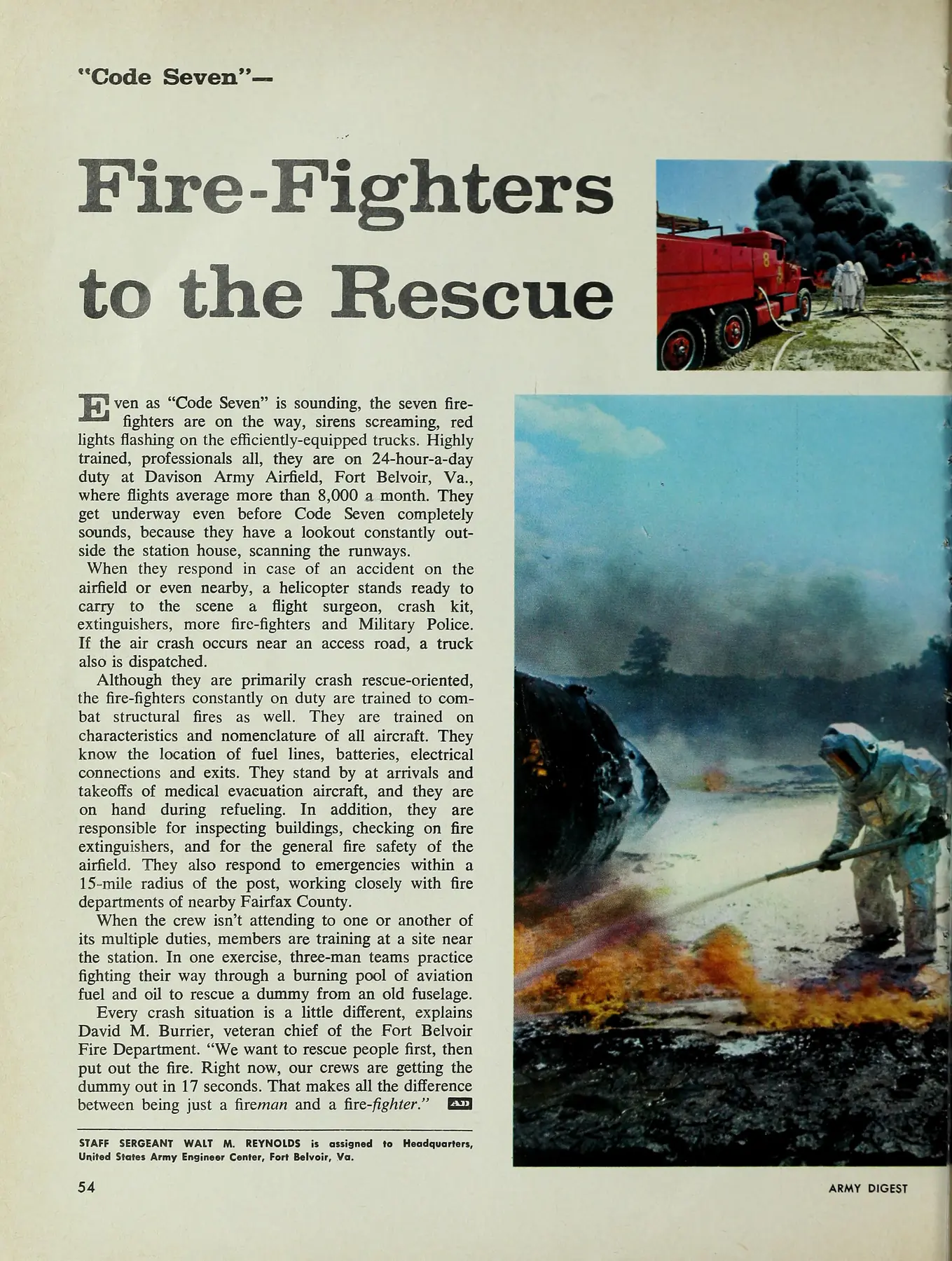
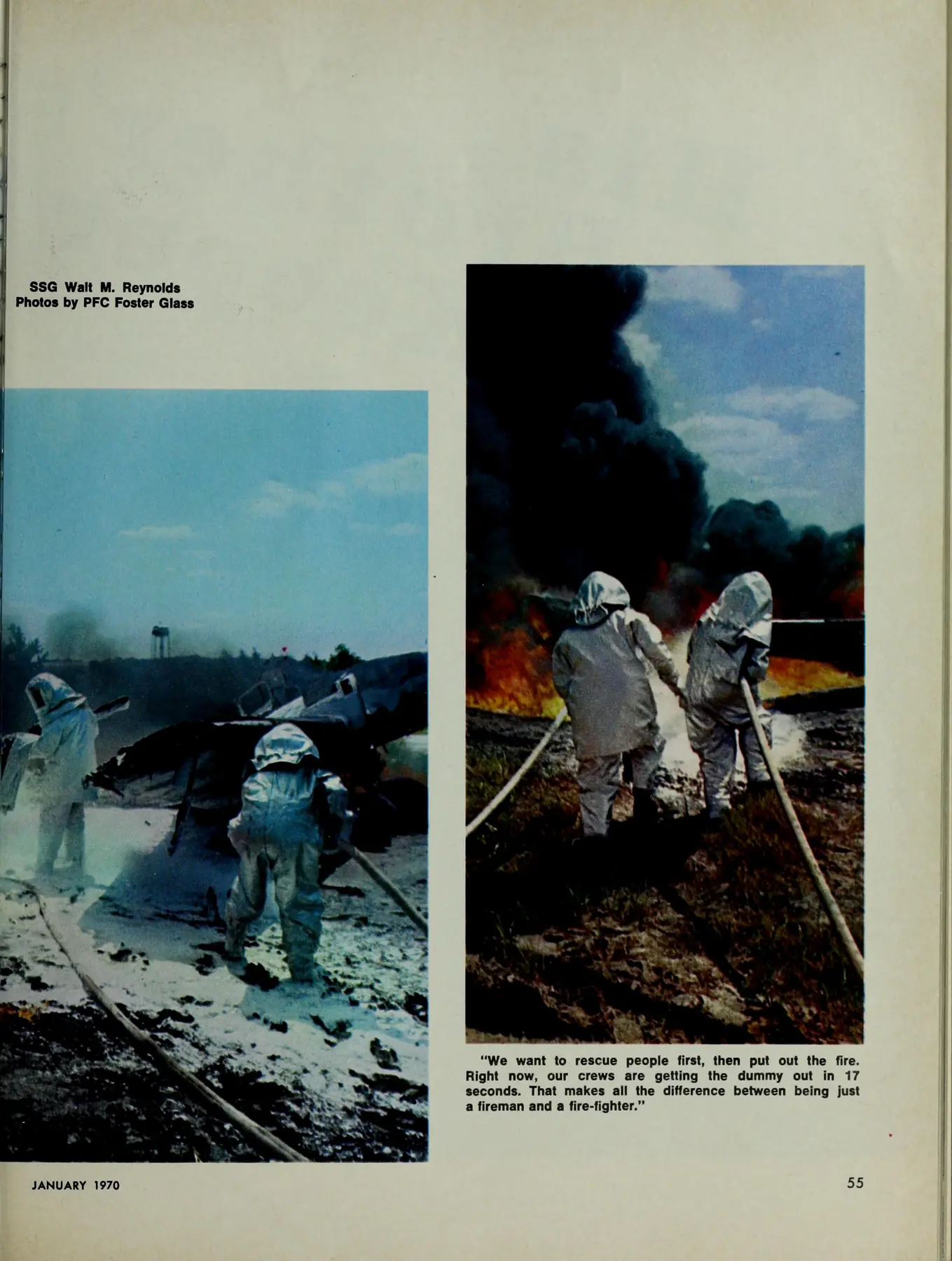
The article identifies and quotes David M. Burrier in its account of fire-and-rescue training. The photographs document the operation described; they do not identify Burrier among the people shown.
Documented factArmy Digest’s contemporary identification of Burrier as Fort Belvoir’s veteran fire chief and its account of the rescue-first training program.
No firefighter pictured is named. The images do not establish that Burrier appears in, or personally participated in, the photographed drill.
Source, credit, and publication review
- Creator
- SSG Walt M. Reynolds; photographs by PFC Foster Glass
- Repository
- University of Florida, George A. Smathers Libraries
- Collection
- Army Digest, vol. 25, no. 1
- Access
- Internet Archive
- Identity review
- Burrier is named in the article text; every firefighter in the accompanying photographs remains unidentified.
- Privacy review
- Manual image review completed 2026-08-31: Burrier is a deceased historical person named in the article; the photographed firefighters are unidentified and their faces are not discernible through protective gear or distance. No private modern information is reproduced.
- Rights checked
- Release reviewed
- · checksums matched
- Web derivative
- Page 54: Full published page; resized without isolating any firefighter.Page 55: Full published page; resized without isolating any firefighter.
Credit: Army Digest, vol. 25, no. 1 (January 1970), ‘Code Seven—Fire-Fighters to the Rescue,’ pp. 54–55; article by SSG Walt M. Reynolds; photographs by PFC Foster Glass. Scan: University of Florida, George A. Smathers Libraries, via Internet Archive.
Family
A family branch with a deliberate public boundary
The record supports David’s marriage and three children. The living generations connecting this branch to other families remain outside the public archive.
Wife
Gladys Vida (Culver) Burrier
Later family records give this full name; David’s 1984 obituary printed “Gladys B. Burrier.” The reconciliation is strong, while an original marriage record remains desirable.
Children and later descendants
Three children — later living names withheld
The obituary establishes three children. This public edition does not expose the living family chain or use present-day descendants to complete a public pedigree.
David’s children and later descendants are described collectively. The living line into another family is not named, indexed, mapped, placed in structured data, or exposed through a download. Private addresses and the unredacted dossier remain outside the public site.
Historical geography
From Baltimore to an Army airfield
The map uses only supported city, installation, airfield, and country-level geography. It supplies no private address and invents no Taiwan location.
- Baltimore / Washington: birth range and 1936 move · source-limited. Connection to Fort Belvoir: Prevention career before federal service, strong.
- Fort Belvoir: assistant chief 1941; chief 1944–1969. Connection to Davison Army Airfield: Installation command into airfield rescue, documented.
- Davison Army Airfield: crash rescue and live-fire training · documented.
Approximate birthplace and early-life setting; no exact address or birth date is established.
Regional
Washington area and Cheverly–Tuxedo, Maryland
Reported 1936 regional move and approximately three years of municipal fire-marshal work.
Assistant chief from 1941, fire chief from 1944, wartime training, and installation fire protection through 1969.
Regional
Taiwan
Country-level association for the firefighting program reported in 1958; no city, base, or receiving organization is yet documented.
Aircraft crash rescue, medical support, runway watch, live-fire training, and mutual aid documented by Army Digest.
Regional
Alexandria and Mount Vernon, Virginia
Later community affiliations and Mount Vernon Hospital death; no residence is mapped.
Evidence ledger
What this page can claim
Each consequential claim carries its own grade. A polished sentence does not outrank the evidence beneath it.
David Monroe Burrier—not Butler—was born in Baltimore about 1911–1912; the exact date remains unresolved.
SourcesB01R01His obituary reported a 1936 move to the Washington area and roughly three years as Cheverly–Tuxedo fire marshal.
SourcesB01He joined Fort Belvoir as assistant fire chief in 1941, became chief in 1944, and retired in 1969 after twenty-five years as chief.
SourcesB01B03R01David was a civilian fire chief at an Army installation; aviation rescue does not make him an Air Force chief or a uniformed officer.
SourcesB01B03R01His obituary reported that he helped train firefighting units for overseas duty during the wartime era.
SourcesB01His obituary reported that he helped establish a firefighting program in Taiwan in 1958; the organization, exact location, duration, and scope remain unresolved.
SourcesB01R01A liquid-oxygen explosion severed a major artery in David’s leg, and Arthur M. Pettit with a second firefighter controlled the bleeding.
SourcesB02R01The precise accident date, project, site, second rescuer, hospital, recovery, and long-term effects remain unresolved.
SourcesB02R01No current evidence connects David’s accident to Redstone missile work; the overlap is a research lead, not a finding.
SourcesB02B08R01Army Digest documented seven firefighters on continuous duty, more than 8,000 monthly flights, and the Davison crew’s rescue-first live-fire drills.
SourcesB03The seventeen-second figure describes a reported training performance, not a universal emergency-response guarantee.
SourcesB03R01The Army Digest photographs document Davison’s operation but do not identify David as one of the firefighters shown.
SourcesB03R01The archive's five evidence grades
Primary or contemporary evidence directly supports the claim.
Serious scholarship or correlated evidence strongly supports the claim.
Accepted in the current reconstruction, but still open to stronger documentation.
A historically documented accusation, presented as an accusation—not as established fact.
The evidence is insufficient, conflicting, or not yet audited.
Research files
Dossiers and source trail
The archive preserves the long-form research behind the page and shows where every citation stands.
About this research edition
The prior dossier, source trail, family proof summary, privacy boundary, and media rights were audited before this page was built. No invented portrait, living-descendant names, or private dossier appears here.
A typography-first biography built from an Army feature, a contemporary accident report, obituaries, an archival Fort Belvoir photograph, later family records, and a reconciled research dossier.
Unredacted research editions are retained outside the public website. A download will appear here only after living-person privacy and every embedded image right have been cleared.
Archival records
B01“David M. Burrier, 72, Retired Fire Chief at Ft. Belvoir”View citation
- Locator
- The Washington Post, 17 March 1984
- Research status
- Located and incorporated; early career, Taiwan, recognition, and community details remain explicitly obituary-reported
- Image / reuse status
- Citation and link only; facts paraphrased and article text or imagery not reproduced
B02“Hero Award”View citation
- Locator
- Northern Virginia Sun, 23 February 1962, p. 12
- Research status
- Located; the page’s detail follows the dossier transcription of searchable newspaper text
- Image / reuse status
- Citation and link only; no newspaper screenshot or clipping reproduced
B03SSG Walt M. Reynolds, “Code Seven—Fire-Fighters to the Rescue”View citation
- Locator
- Army Digest, January 1970, pp. 54–55; photographs by PFC Foster Glass
- Research status
- Located, transcribed, and checked against the complete issue
- Image / reuse status
- The issue permits reprinting unless otherwise indicated with credit to Army Digest and the author; no contrary notice appears on pp. 54–55
B04Royden Dixon, “Fort Belvoir, Virginia. Soldiers”View citation
- Locator
- Library of Congress, May 1941, LC-USF34-014509-D
- Research status
- Located; official catalog number corrects a digit transposition in the earlier dossier
- Image / reuse status
- Public domain / no known restrictions, but editorially rejected for David’s biography because the record identifies neither David nor fire-department activity
B05Diana May O’Connor memorialView citation
- Locator
- Welch Funeral Home memorial, 2023
- Research status
- Located and used only for later family-name corroboration
- Image / reuse status
- Citation and link only; memorial text, photographs, and living survivor details not reproduced
B06Gladys Burrier obituaryView citation
- Locator
- The Washington Post via Legacy, 2010
- Research status
- Located and used only for family-name corroboration
- Image / reuse status
- Citation and link only; obituary text and photographs not reproduced
Published scholarship
B07Fort Belvoir Fire & Emergency ServicesView citation
- Locator
- Official U.S. Army installation page
- Research status
- Current institutional context only; not used as proof of David-era details
- Image / reuse status
- Citation and link
B08523rd Engineer Company unit-history compilationView citation
- Locator
- Compiled history of a 1957 Fort Belvoir liquid-oxygen support mission
- Research status
- Contextual lead only; no person-level connection to David’s accident
- Image / reuse status
- Citation and link only
Research editions
R01David Monroe Burrier Illustrated Family-History DossierView citation
- Locator
- Prepared August 2026 · private archive control edition
- Research status
- Controlling synthesis for chronology, source trail, cautions, and image integrity
- Image / reuse status
- Private and not downloadable; living names and reproduced source pages require redaction and separate release review
R02Private Burrier–Whitely Genealogical Proof SummaryView citation
- Locator
- Prepared August 2026 · private family-line control
- Research status
- Used only to preserve the private relationship chain and publication boundary
- Image / reuse status
- Private and not downloadable; the living connection is omitted from the public archive
Publication rule: a record's existence, a verified citation, an available image, and legal permission to reproduce that image are four different things. Subscription-service images and rights-unclear scans remain citation or link only.
Research desk
Open questions
These are the page's next assignments, not gaps to hide.
- 01
Can a Baltimore birth, baptismal, Social Security, cemetery, or church record establish David’s full birth date?
- 02
Can an original marriage record confirm Gladys’s full name and explain the “Gladys B.” / Gladys Vida discrepancy?
- 03
Can David’s federal civilian Official Personnel Folder confirm each appointment, promotion, assignment, award, and retirement action?
- 04
Which wartime firefighting units did David help train, and where were they sent?
- 05
Did David travel to Taiwan in 1958, under which authority, and for how long?
- 06
Which Taiwanese organization received the program, and did it serve an airfield, installation, municipality, or industrial site?
- 07
What was the exact date, site, project, and experimental purpose of the liquid-oxygen work?
- 08
Who was the unnamed second firefighter who helped Arthur M. Pettit stop the bleeding?
- 09
Does a safety report, line-of-duty record, hospital record, or award citation document David’s recovery?
- 10
Was the accident connected to Redstone-support work, or is the apparent overlap unrelated?
- 11
Where are the official records behind the reported commendations, fourteen fire-prevention awards, and two Defense Department medals?
- 12
Can a captioned department or family photograph provide an authenticated portrait of David?
- 13
Can any firefighter in the Army Digest photographs be independently identified without relying on resemblance?