Executor
The person named in a will to administer the estate: collect assets, settle obligations and carry out the will.
Andrew appears as executor of William—not automatically as the person who originally owed each debt.
A farmer. Two stills. Seven men named in sworn complaints. Then a sheriff trying to sell the farm.
Pause to read. Start again wherever you like.
Continuous Ninajirachi remixes. No voiceover. The documents do the talking, with time to find your way around the maps.
Cumberland County, the mountain to the north and the Susquehanna to the east. Take your time with the names.
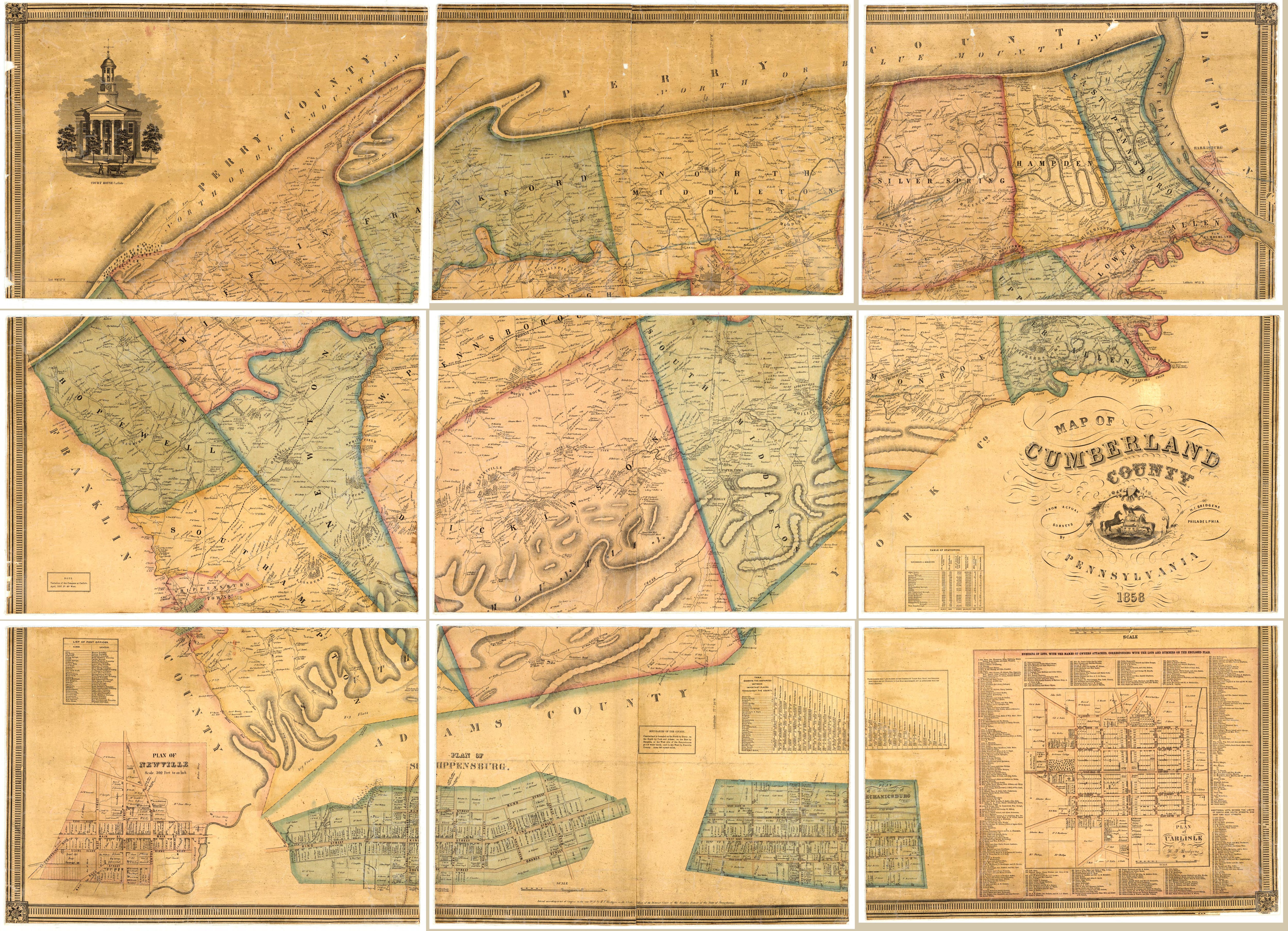
1858 map · Geographic orientation. William’s farm was in East Pennsborough. Andrew’s later purchase was in North Middleton. The map shows later township boundaries and property names; it does not mark the exact location of William’s farm.
H. F. Bridgens, Map of Cumberland County, Pennsylvania, 1858 · Pennsylvania State Archives, MG 11, Map 75. The whole map preserves the scan sections and their visible joins.
The words sound intimidating. Here is what they mean in William’s records—and why the distinction matters.
The person named in a will to administer the estate: collect assets, settle obligations and carry out the will.
Andrew appears as executor of William—not automatically as the person who originally owed each debt.
A court-authorized person administering an estate.
Jacob Miller acts as administrator of Christopher Miller’s estate. That title alone does not prove he was Christopher’s son.
The deceased person’s property and obligations while they are being administered.
A beneficiary can inherit under a will while creditors still have claims to settle.
The person giving sworn evidence.
In the two surviving complaints, William is the deponent. The complaints record his accusations.
A recorded conditional obligation securing someone’s appearance in court.
Martin Herman and Philip Weaver were bound to appear and testify. The named amount is not proof that they paid a fine.
The grand jury allowed the indictment to proceed.
It is a decision to bring a charge forward, not a finding that the defendants were guilty.
The plea is the defendant’s answer to a charge. The verdict is the jury’s decision.
The January 1808 plea notation and the undated not-guilty verdict are separate entries.
The court put the prosecution costs on the county in this result.
The photographed acquittal concerns Big John and Tobias Miller.
A formal written court order.
These writs tell the sheriff what to do. They are instructions, not invoices.
Enforcement of a court’s money judgment through property.
Here, the court’s decision has reached the sheriff. The word concerns collection.
The sheriff subjects or seizes a property interest for legal enforcement.
The farm is brought under the court’s collection process.
An inquiry by the sheriff and jurors.
Here they tested whether seven years of net rents and profits could satisfy the particular debt. They were not setting a market price.
Passed into the sale process following the required inquiry.
This wording does not mean the house was unsafe or the land worthless.
A further order to expose already-taken property to sale.
Plain English: sell the property already under the sheriff’s control.
A public auction.
Same auction. Much fancier fucking wording.
The sheriff’s report back to the court about what happened under a writ.
“Not sold for want of buyers” describes an unsuccessful attempt before the later completed sale.
A session of the court.
A writ issued in November can be returnable at the following January term.
A separately adjudged money award on the civil form.
The Miller writ says the $75.75 arose from detention of the debt: delayed or withheld payment. It is not stated as compensation for the assault.
Adjudged liable in this civil action.
It does not establish a second criminal conviction or overturn the assault acquittal.
A deed executed by one party.
Here, the sheriff conveys title following the sale.
Formal recognition of the deed.
The farm sold on 9 August 1811. The deed was acknowledged on 11 January 1812. Those are different events.
The valuation or category used for taxation.
William’s listed assets are not an audited net worth, an auction price or proof of the tax paid.
One hundred three pounds, sixteen shillings and three pence in the record’s historical units.
Keep this separate from the $75.75 damages and the $4,200 auction price. Adding different currencies would produce nonsense.
A period term for an ordinary farmer or landholder.
It is not a noble title or a complete statement of someone’s wealth.
No matching word. Try part of the term, such as “deed” or “sale.”
These are historical explanations of the documents in this film. The source guide includes the Pennsylvania court-records reference used to check the process.
Opening with Ninajirachi — Delete (ISAMOX Flip), followed by four more remixes from our existing collection.
Full music credits · Read the film · Plain text version · Follow the historical sources