Read the film · Seven chapters · 15:28

The First Edwin

A name. A life. A world still visible.

The story, scene by scene.

The complete onscreen text. Select a timestamp to return to that moment in the film.

Chapter 1 · A Name That Stayed

0:00 ↗

CARROLLTOWN · SEPTEMBER 2026

The First Edwin

A name led back to this grave. Father Edwin Pierron had died in 1930, but his name still had a place in a family nearly a century later. The visit opened a larger question: what kind of life had made people remember him?

View the image ↗ · A family visit to St. Benedict’s Cemetery, Carrolltown, September 2026.

September 2026 visit photographs and account

0:28 ↗

PHILADELPHIA · 1925

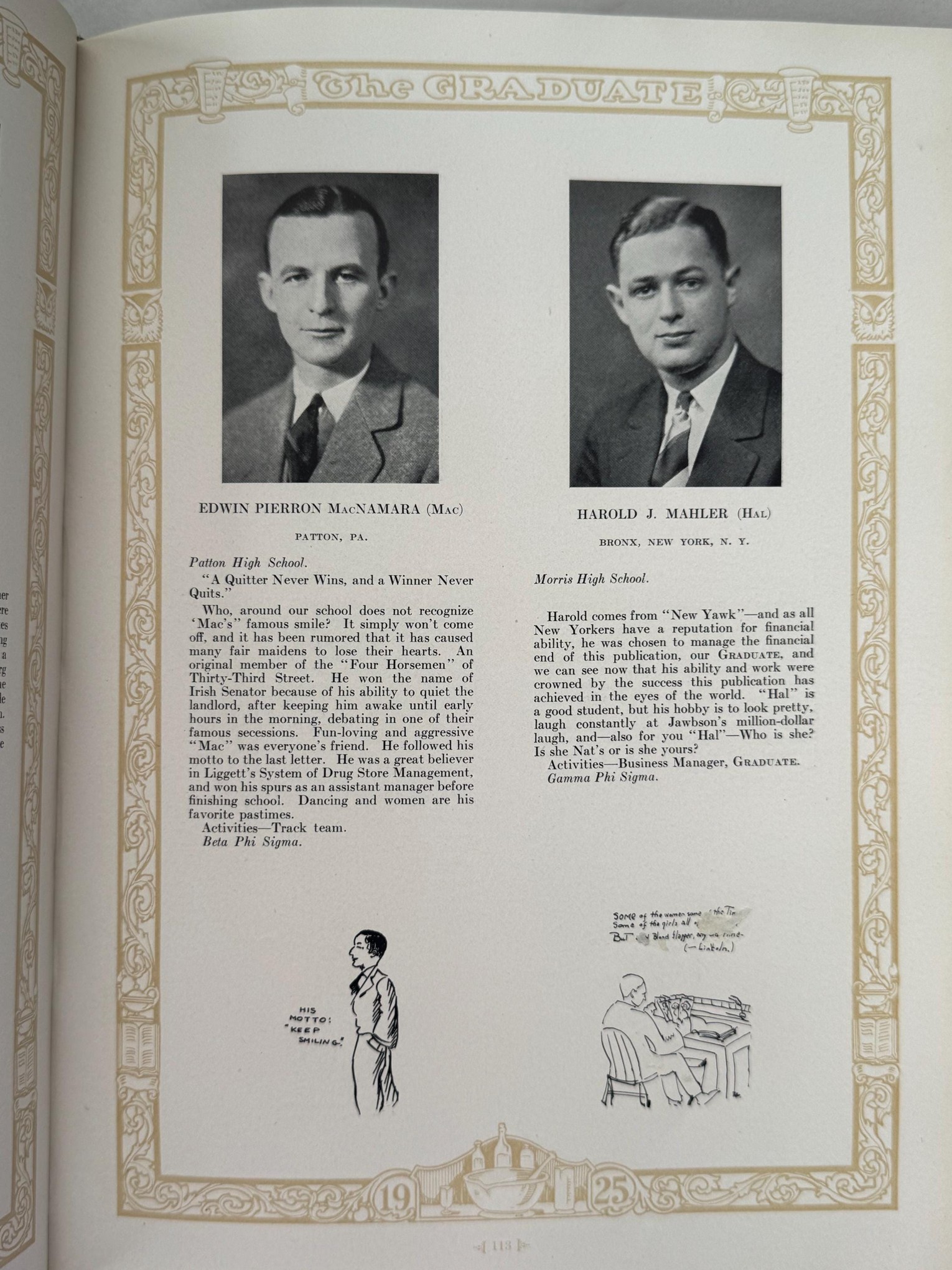
A Name on the Page

The name is visible in a college yearbook: Edwin Pierron MacNamara, from Patton, Pennsylvania. He was the filmmaker’s great-grandfather. Family tradition connects that name to Father Edwin. A priest’s name had entered a family’s story, and the yearbook placed it beneath the face of a young man beginning his own career.

View the image ↗ · Edwin Pierron MacNamara’s yearbook entry, 1925.

The Graduate, Philadelphia College of Pharmacy and Science, 1925, p. 118

0:56 ↗

PATTON · PORTRAIT PUBLISHED 1899

The Man Behind the Name

Father Edwin was an immigrant, a Benedictine monk, a priest, a teacher, and a collector of plants. He helped congregations establish themselves in growing Pennsylvania towns. To understand the name that survived, we have to follow the work and the places of the man behind it.

View the image ↗ · Father Edwin Pierron; portrait published in 1899. Sitting date unknown.

Patton Courier, 20 April 1899, p. 1

Chapter 2 · Across the Atlantic

1:24 ↗

BELGIUM TO WISCONSIN · CHILDHOOD

Across an Ocean

Born on Christmas Day in 1846, Edwin came to America with his parents while still a child, according to Benedictine historian Modestus Wirtner. Their American home was at St. Nicholas, Wisconsin. His later life would carry him east to Pennsylvania and south to North Carolina, linking very different communities through his work.

View the image ↗ · Modern orientation map of documented American settings; no exact travel route is asserted.

Wirtner, The Benedictine Fathers in Cambria County, Part II (1930), Pierron biography

1:56 ↗

WISCONSIN · MAP PUBLISHED 1873–74

A Landscape Before the Monastery

Farms, roads, churches, and a railway organize this landscape along Lake Michigan. Property lines divide the fields; roads connect them with settlements and the shore. Published in 1873–74, the map gives the Wisconsin setting a visible scale. It helps us understand the agricultural region where Wirtner places Edwin’s immigrant childhood.

View the image ↗ · Belgium township and Lake Michigan, mapped in 1873–74 after Edwin’s departure. Regional context; childhood home unidentified.

Nash and Tucker, Washington and Ozaukee counties map, 1873–74; UWM item 22196

Chapter 3 · The Benedictine

2:28 ↗

SAINT VINCENT · 1869

Entering a Different Life

In 1869, Edwin entered Saint Vincent in Pennsylvania. The college and monastery brought study and religious community into the same setting. This drawing, made in 1872, lets us see that environment during his early years there: buildings, grounds, and a working landscape around the young Benedictine.

View the image ↗ · Saint Vincent in 1872, drawn by Father Lucas Wimmer; published in 1873.

Lucas Wimmer drawing, 1872; Moosmüller, St. Vincenz in Pennsylvanien (1873), plate III; Library of Congress

2:56 ↗

SAINT VINCENT · FIRST VOWS, 1870

What Benedictine Meant

A Benedictine belongs to a monastic community following the Rule of Saint Benedict. Prayer, work, and learning give that life its shape. Wirtner dates Edwin’s first vows to December 28, 1870. The letters O.S.B., later printed beside his name, identify his membership in the Order of Saint Benedict.

View the image ↗ · A detail of the 1872 college and monastery drawing; Pierron is not identified in the scene.

Wirtner, 1930, Pierron biography; contemporary Saint Vincent drawing

3:24 ↗

SAINT VINCENT · ORDINATION, 1874

A Priest and a Teacher

He was ordained a priest on December 14, 1874. His monastic vows joined him to a religious community; ordination brought the ministry of Mass and the sacraments. Teaching English and Latin formed part of his early work. The classroom and the church gave him different ways to serve within the same institution.

View the image ↗ · Father Edwin; portrait credited to Saint Vincent Archabbey. Sitting date unknown.

Wirtner, 1930, Pierron biography; portrait reproduced in Belmont history, 1997, p. 42

Chapter 4 · A Wider World

3:52 ↗

WESTMORELAND COUNTY · 25 SEPTEMBER 1877

Something He Left Behind

This grass specimen is a small, surviving connection to his scientific work. Its label names P. E. Pierron and St. Vincent College, Pennsylvania. A handwritten date reads September 25, 1877, and the collecting locality is Westmoreland County. The object is preserved today in the Herbier Tourlet at the University of Tours.

View the image ↗ · Pierron specimen, dated 25 September 1877. Université de Tours, CC-BY-NC.

Université de Tours, Herbier Tourlet, HG06436.02, item 52881

4:22 ↗

THE BOTANICAL RECORD · 1877

A Name Travels Further

The specimen’s historical label calls the plant Andropogon furcatus. Harvard also catalogs a letter from P. Edwin Pierron to the botanist Lester F. Ward, dated November 12, 1877. That letter remains unread. Its existence points toward a conversation still waiting to be recovered; we cannot yet supply its words.

View the image ↗ · The surviving specimen is shown; the separately cataloged Harvard letter has not been recovered.

Tours HG06436.02; Harvard Walter Deane papers, gra00073, Box 22, Folder 12

4:50 ↗

BELMONT, NORTH CAROLINA

A School in the South

His work also took him to Belmont, North Carolina, and St. Mary’s College. The college, monastery, and church appear together in this photograph published in 1901. Their arrangement makes the institution’s purpose visible: education and religious life occupied the same campus. Father Edwin became part of the school’s early leadership.

View the image ↗ · Belmont college, monastery, and church; photograph by Van Ness, published in 1901. Exposure date unknown.

Souvenir St. Peter’s Catholic Church, 1851–1901, PDF p. 11

5:18 ↗

BELMONT · RECTOR, 1882–1884

Responsibility for a College

Belmont’s institutional history lists Father Edwin as rector from 1882 to 1884. The rector handled the college’s day-to-day administration under its president. Teaching had grown into responsibility for a school. The portrait preserves his face beside that office, giving a particular person to the institution’s list of early leaders.

View the image ↗ · Father Edwin’s portrait in Belmont’s institutional history; original sitting date unknown.

Baumstein and Estes, Blessing the Years to Come (1997), pp. 41–42

Chapter 5 · Building a Community

5:46 ↗

NORTHERN CAMBRIA COUNTY · 1880s–1890s

Congregations Taking Root

Carrolltown, Hastings, Spangler, and Patton became the next landscape of his work. Wirtner describes his assignment to organize the Hastings congregation in 1890; St. Bernard’s was dedicated in January 1891. He then helped organize churches in Spangler and Patton while still serving Hastings. These communities overlapped in one priest’s working life.

View the image ↗ · Northern Cambria County, mapped in 1867; the map predates several towns’ later development.

Wirtner, 1930, Hastings account and Patton/Spangler establishment histories

6:18 ↗

HASTINGS · NOVEMBER 1895

The Town Around the Congregation

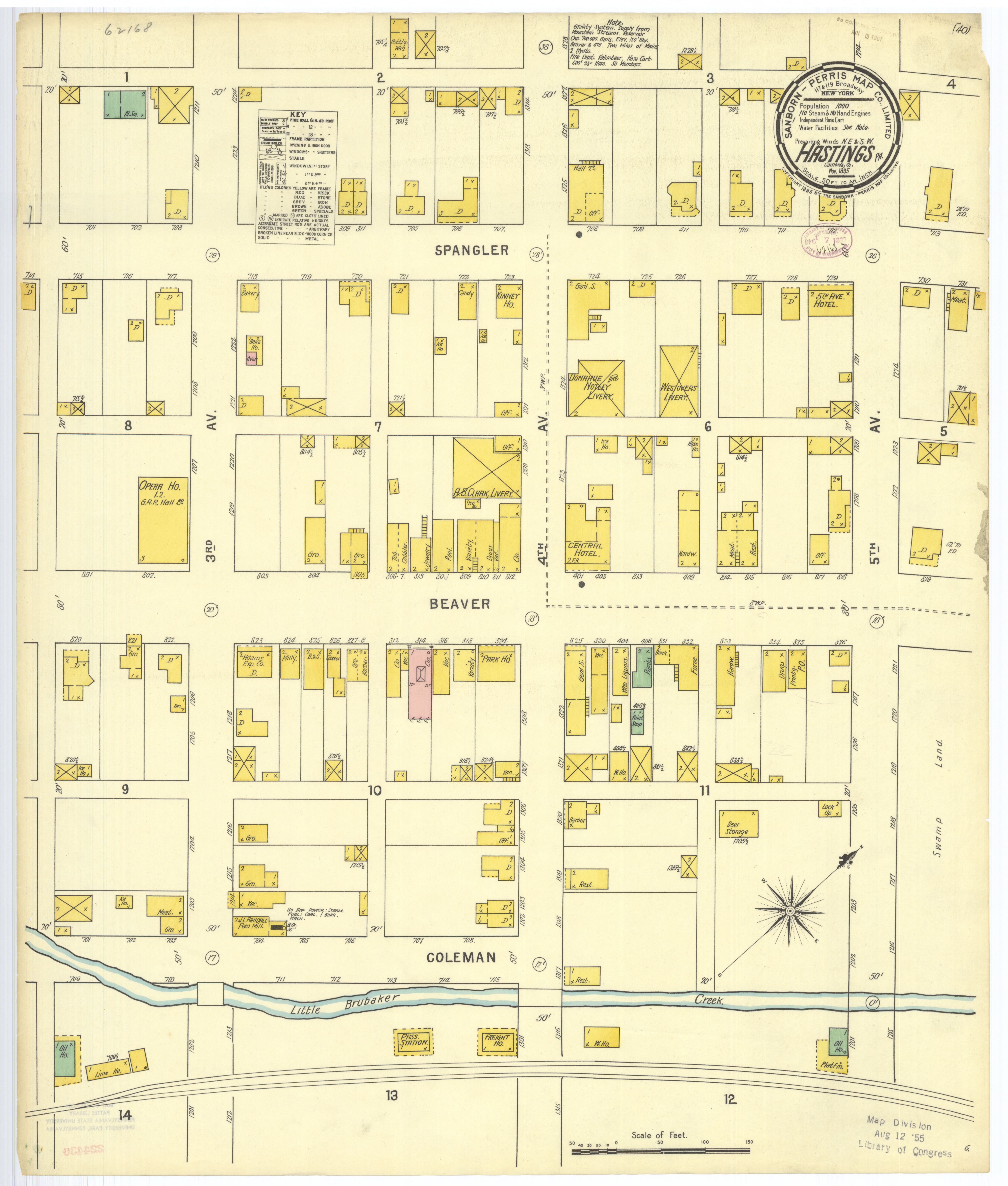
This map brings Hastings into focus during Father Edwin’s years there. Shops, hotels, livery stables, and railway facilities stand close to Little Brubaker Creek. Passenger and freight stations connect the town with a wider world. The new congregation took its place among these streets, businesses, and the practical arrangements of everyday life.

View the image ↗ · Hastings, November 1895: businesses, creek and railway facilities. The map establishes setting, not Father Edwin’s travel route.

Sanborn, Hastings, November 1895, sheet 1; Penn State item 11008

6:50 ↗

PATTON · AUGUST 1898

Returning to Stay

After brief assignments in Pittsburgh and Baltimore, Father Edwin returned to Patton as its resident pastor in August 1898. A parish was the people gathered around local worship and service, as well as their church. His work here would continue until retirement in 1922, spanning much of a generation.

View the image ↗ · St. Mary’s Church in Patton, pictured in the Courier in April 1899.

Wirtner, 1930, Pierron biography; Patton Courier, 20 April 1899, p. 1

7:18 ↗

PATTON COURIER · 20 APRIL 1899

A Church Comes into View

The newspaper put the church and its pastor before the town. Its April 20, 1899 issue pictured St. Mary’s and announced the dedication planned for the following Sunday, April 23. The portrait and building share this original page. Together, they make a parish appointment into a face and a place.

View the image ↗ · Original newspaper page announcing the forthcoming dedication and picturing church and pastor.

Patton Courier, 20 April 1899, p. 1

7:46 ↗

PATTON · DECEMBER 1910

Inside the Street Map

The Sanborn map places St. Mary’s within its neighborhood. Its practical labels record brick construction, steam heat, electric lighting, and a tower one hundred feet high. Streets and nearby buildings put the church into the scale of everyday Patton. The congregation’s gathering place was also a substantial part of the town’s built landscape.

View the image ↗ · St. Mary’s Roman Catholic Church, December 1910. Penn State University Libraries.

Sanborn, Patton, December 1910, sheet 3; Penn State item 24875

8:18 ↗

ST. MARY’S · 11 JUNE 1901

A Very Early Wedding

At five o’clock on a Tuesday morning, Julia Supart and Edward Dietrich were married at St. Mary’s by Father Edwin Pierron. The Pittsburgh Catholic preserved the date, the couple, the priest, and that remarkably early hour. Among the larger milestones of parish history, this small notice brings one working morning into focus.

View the image ↗ · The contemporary notice of the five-o’clock wedding on 11 June 1901.

Pittsburgh Catholic, 26 June 1901, p. 13, Cambria County Notes

8:46 ↗

PATTON · BEFORE 1900

Making Room

A later history of Patton’s Byzantine Catholic parish remembers Father Edwin allowing its faithful to hold services in St. Mary’s before they acquired their own church in 1900. That account preserves a practical act of hospitality. The precise date remains unknown, but the remembered arrangement was simple: another community could worship here.

View the image ↗ · The Patton church, now Queen of Peace, photographed in September 2026; modern view.

Byzantine Archeparchy of Pittsburgh, Saints Peter and Paul, Patton, institutional parish history

9:14 ↗

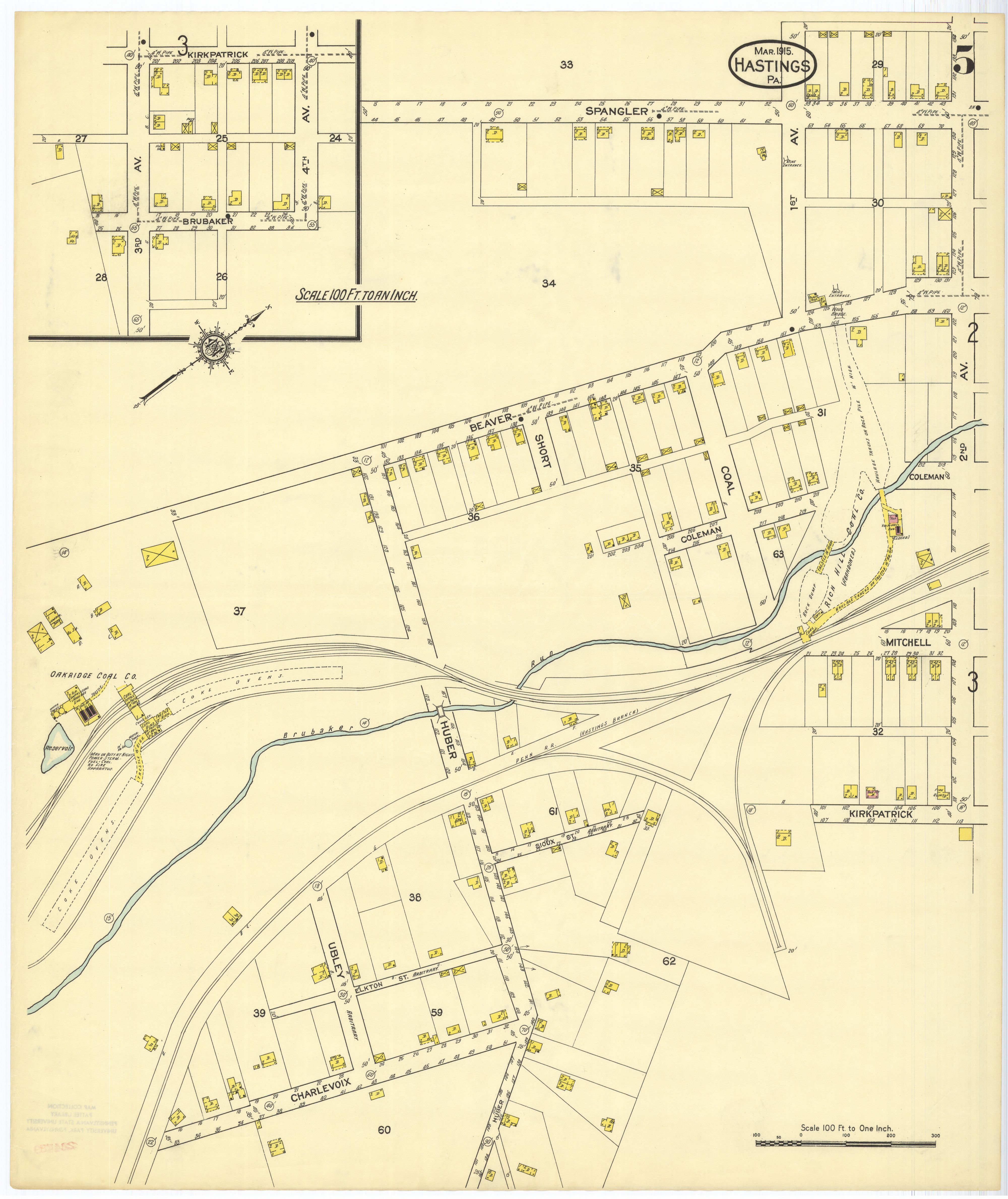
HASTINGS · MARCH 1915

Coal, Coke, and the Railway

A later map reveals another part of the district’s working landscape: coal works, coke ovens, and the Pennsylvania Railroad’s Hastings Branch. It dates from 1915, after Father Edwin’s Hastings service. Rich Hill is explicitly marked abandoned. The drawing preserves both industrial activity and its remains around the communities he had helped serve.

View the image ↗ · Industrial Hastings, March 1915. Rich Hill Coal Co. is marked abandoned. Later geographic context.

Sanborn, Hastings, March 1915, sheet 5; Penn State item 11013

9:46 ↗

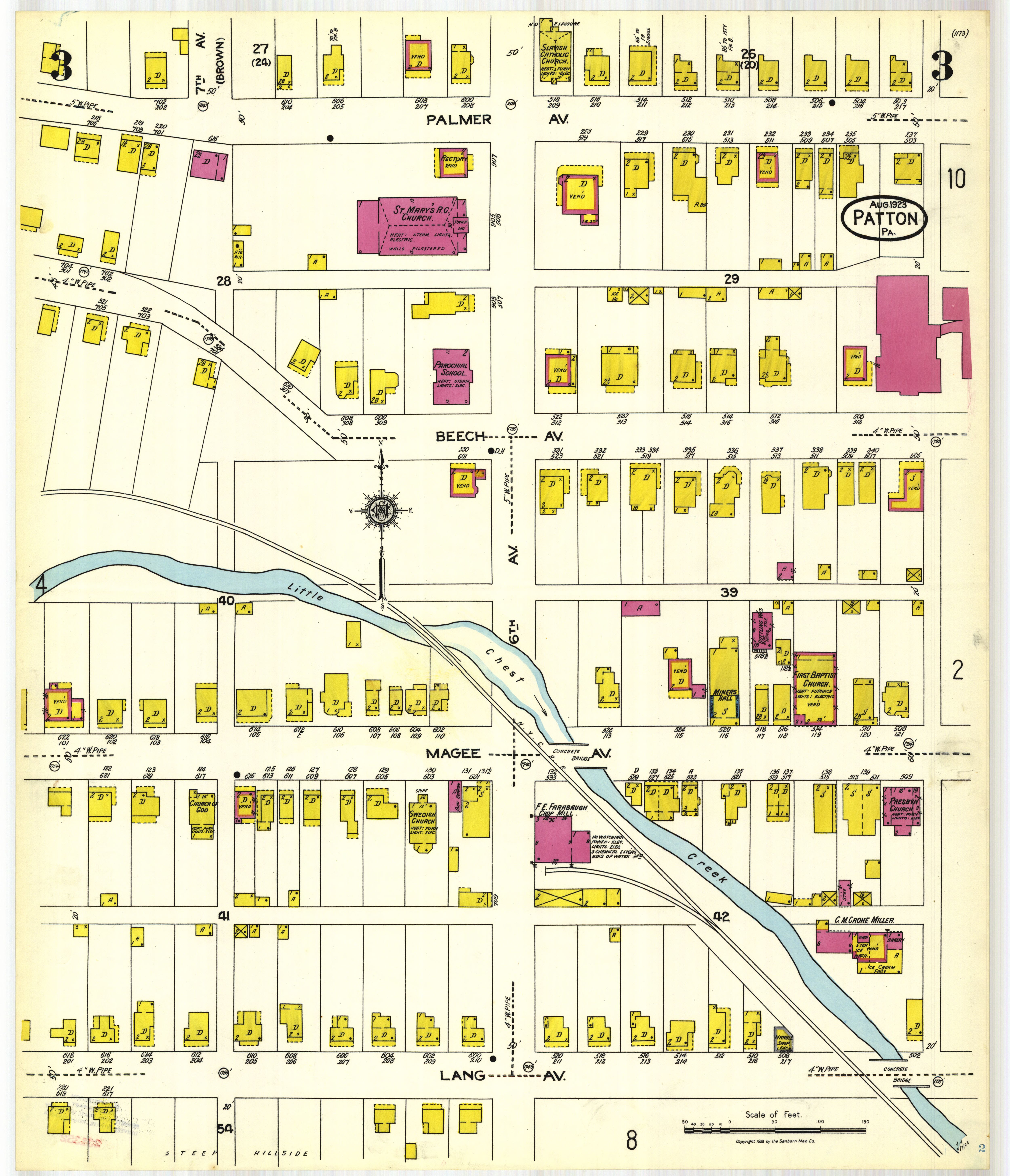
PATTON · RETIREMENT, 1922

The Work Outlasts the Appointment

Father Edwin retired in 1922 and remained in Patton. The following year’s map names St. Mary’s church, its rectory, and its parochial school. Worship, education, and parish administration now appear together on the block. The community continued its daily life through institutions whose place in the town can still be traced.

View the image ↗ · St. Mary’s church, rectory and parochial school, August 1923, after retirement; the rectory is not identified as his retirement home.

Sanborn, Patton, August 1923, sheet 3; Penn State item 28472; Wirtner, 1930, Pierron biography

Chapter 6 · Food for Thought

10:18 ↗

PATTON COURIER · 3 OCTOBER 1901

Food for Thought

One short newspaper item brings his public concerns unusually close. Reporting a Sunday sermon at St. Mary’s, the Courier says Father Pierron addressed the causes of anarchy and paid particular attention to recent lynchings in the South. The notice also points to other lawlessness tolerated by the American public.

View the image ↗ · The original newspaper report of Father Pierron’s sermon; this is not a full transcript.

Patton Courier, 3 October 1901, p. 1, column 2, Food for Thought

10:48 ↗

THE NEWSPAPER’S ACCOUNT

Beyond the Church Walls

The report brings a national question into a local parish story. It describes a sermon about lynchings, anarchy, and lawlessness that Americans tolerated. Father Edwin’s ministry included asking people to think about events beyond their own streets. The newspaper carried that concern outward again, from the church into the town’s printed record.

View the image ↗ · Contemporary summary; the specific lynchings and Father Edwin’s exact wording are not supplied.

Patton Courier, 3 October 1901, p. 1, column 2

11:16 ↗

ST. MARY’S · A CONTINUING QUESTION

What People Were Asked to Consider

The Courier concluded that there was serious thought in his remarks. Its brief account places public responsibility alongside the familiar work of parish ministry. Weddings and church buildings tell us whom he served and where. This notice also shows a subject he brought before his congregation: violence, and the willingness to overlook it.

View the image ↗ · Queen of Peace interior, September 2026; a modern view, not a reconstruction of the 1901 service.

Patton Courier, 3 October 1901; September 2026 church photograph

Chapter 7 · What Remains

11:44 ↗

PATTON · JANUARY 1930

A Life Comes to Its Close

Father Edwin died on January 30, 1930, after remaining in Patton through his retirement. His monument records a life beginning on Christmas Day 1846. Between those dates lay migration, religious formation, teaching, collecting, and decades of parish work. The stone brings that long movement to a single place in Carrolltown.

View the image ↗ · Father Edwin’s monument, St. Benedict’s Cemetery, Carrolltown; September 2026 photograph.

Grave inscription; Wirtner, 1930; Patton Courier, 13 February 1930, p. 4

12:12 ↗

PATTON COURIER · 13 FEBRUARY 1930

The Picture Issue Sold Out

The Courier reported that its previous issue, carrying Father Edwin’s picture, had sold out by Thursday evening. More people arrived asking for copies on Friday and Saturday. The newspaper had to turn readers away. After a lifetime of public service, his picture was something people in the town wanted to keep.

View the image ↗ · The February 1930 notice survives; the preceding picture issue remains unrecovered in this project.

Patton Courier, 13 February 1930, p. 4

12:40 ↗

A CONTEMPORARY MEMORIAL · 1930

Remembered for Practical Help

An unsigned tribute remembered his practical help, his medical interests, and the respect he received across religious affiliations. The writer described the person through what he had offered others. Beside the churches, the specimen, and the everyday notices, this memorial preserves another part of his legacy: how someone in his community remembered his usefulness.

View the image ↗ · An unsigned contemporary tribute; its medical references do not establish professional credentials.

Patton Courier, 13 February 1930, p. 4, A Tribute (Communicated)

13:08 ↗

THE FAMILY RECORD · 1925

The Name Had Already Continued

Five years before Father Edwin’s death, a pharmacy graduate from Patton appeared in this yearbook as Edwin Pierron MacNamara. The entry remembers his smile, friendships, and student life. He was a different man with his own future. Within that ordinary college portrait, the priest’s distinctive name had found another life.

View the image ↗ · Edwin Pierron MacNamara, the filmmaker’s great-grandfather; left-hand entry.

The Graduate, Philadelphia College of Pharmacy and Science, 1925, p. 118

13:36 ↗

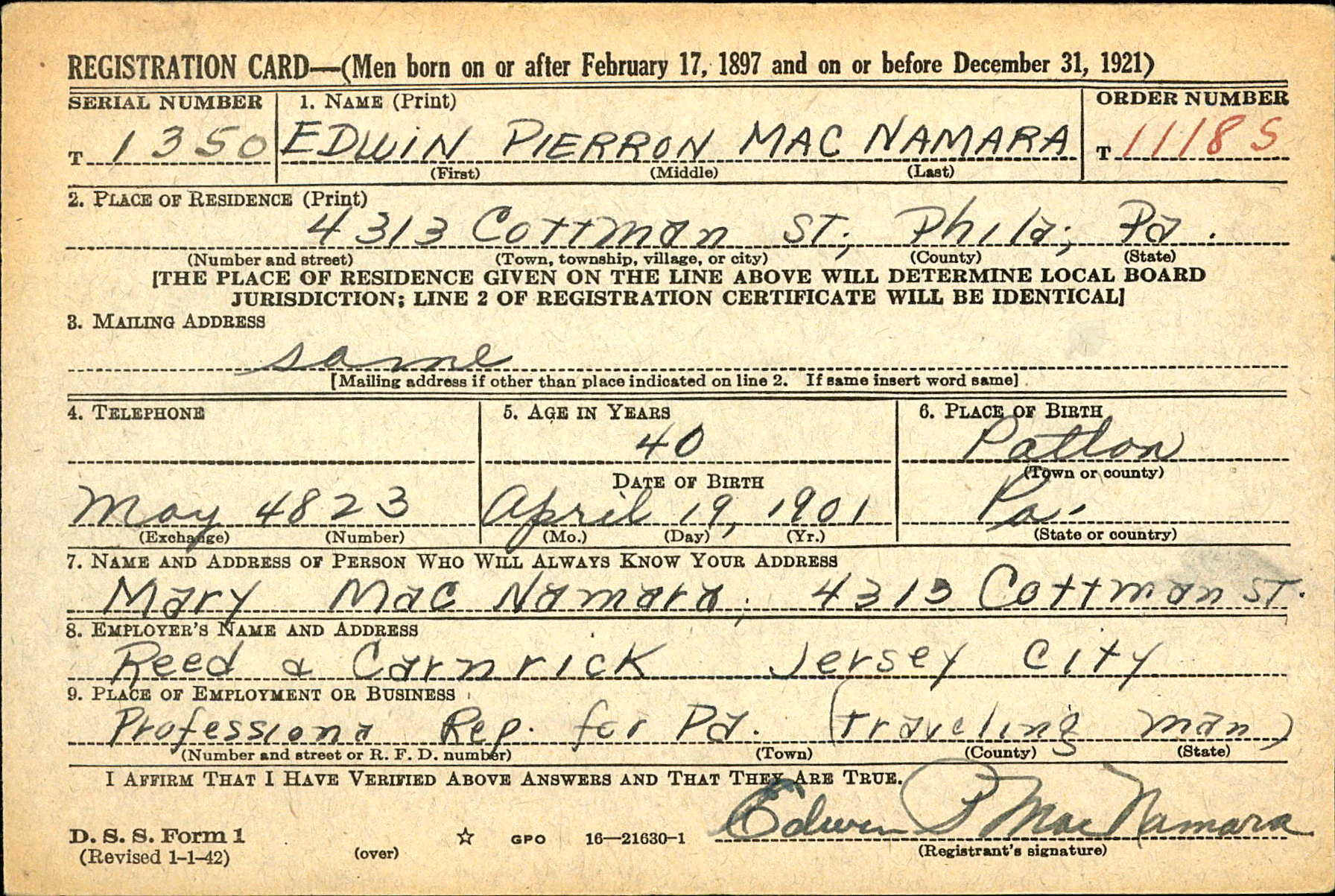
THE FAMILY RECORD · 1942

Written Again in His Own Lifetime

The 1942 draft registration spells the name out again: Edwin Pierron Mac Namara. Patton appears as his birthplace, Philadelphia as his home, and pharmaceutical work as his occupation. Seventeen years after the college yearbook, the distinctive middle name remained part of his public identity, written into another record of an ordinary working life.

View the image ↗ · Original 1942 registration. The name supports family naming tradition; it does not establish a baptism or naming decision.

Edwin Pierron Mac Namara, 1942 draft registration, front

14:04 ↗

PATTON · SEPTEMBER 2026

Returning to the Place

The church could still be visited. Its present name is Queen of Peace, and these photographs record it in September 2026. A building encountered in newspapers and maps now had the scale of a real place. The visit joined the surviving records to streets, walls, and rooms that could be seen firsthand.

View the image ↗ · Queen of Peace, formerly St. Mary’s, September 2026; modern appearance does not date every visible feature.

September 2026 visit photographs and account

14:32 ↗

CARROLLTOWN · SEPTEMBER 2026

The Distance Becomes Personal

At the cemetery, the name on the stone met the family story that had carried it forward. Father Edwin’s life had become part of a later family’s remembrance through its naming tradition. Following that connection led back to his own work, and to communities whose history reaches far beyond a single family.

View the image ↗ · The 2026 visit returns to the opening place. Father Edwin is a namesake, not an established biological ancestor.

Family naming tradition; 1925 and 1942 name records; September 2026 visit

15:00 ↗

THE FIRST EDWIN · A CONTINUING HISTORY

Created by E = MC³

Dedicated to the world Father Edwin helped build. Churches, classrooms, collections, newspapers, and family memory preserve different parts of his life. Brought together, they reveal the reach of one person’s work. This history continues with the people who keep its records, visit its places, and carry its questions into another generation.

View the image ↗ · Father Edwin Pierron, O.S.B. · 1846–1930. Portrait published in 1899.

Patton Courier, 20 April 1899, p. 1; historical sources and visual credits listed below.

Read the landscape

The town around the story.

Open each original map to read its labels, or follow the link to Penn State’s archive.

St. Mary’s church, rectory and parochial school in Patton, mapped in August 1923.

August 1923

Patton: church, rectory and school

St. Mary’s church, rectory and parochial school in Patton, mapped in August 1923.

Mapped in 1923, after Father Edwin’s 1922 retirement from the Patton parish.
Hastings in November 1895: shops, hotels, livery stables, and passenger and freight stations beside Little Brubaker Creek.

November 1895

Hastings: streets and stations

Hastings in November 1895: shops, hotels, livery stables, and passenger and freight stations beside Little Brubaker Creek.

Town geography, not a reconstruction of a personal journey.
Coal, coke and railway geography around Hastings in March 1915. The map labels Oakridge Coal Co., coke ovens, and the Pennsylvania Railroad’s Hastings Branch.

March 1915

Hastings: coal, coke and railway

Coal, coke and railway geography around Hastings in March 1915. The map labels Oakridge Coal Co., coke ovens, and the Pennsylvania Railroad’s Hastings Branch.

Rich Hill Coal Co. is marked abandoned; the sheet contains separately oriented sections.

Evidence behind the story

Historical sources & visual credits

Period newspapers, a labeled botanical specimen, dated maps and family name records give this life its physical traces. Wirtner’s 1930 biography supplies much of the chronological framework through a proofread transcription; the companion separates those accounts from inspected originals.

  1. Contemporary newspaper

    Patton Courier, 20 April 1899, page 1 ↗

    Father Edwin’s portrait and the church he served in Patton. The printed page and its dated images appear in the film.

  2. Contemporary sermon report

    “Food for Thought,” Patton Courier, 3 October 1901, page 1 ↗

    The newspaper’s account of a sermon condemning lynchings and lawlessness. This is a report of the sermon, not its complete transcript.

  3. Contemporary remembrance

    Patton Courier, 13 February 1930, page 4 ↗

    The sold-out portrait issue and the published tribute describing practical help and Father Edwin’s place in the community.

  4. Original specimen label

    1877 botanical specimen, Herbier Tourlet HG06436.02 ↗

    P. E. Pierron’s name, St. Vincent College address and September 25, 1877 date appear on the surviving label. Photograph © Université de Tours, CC-BY-NC.

  5. Institutional history

    Saints Peter and Paul parish history, Patton ↗

    The Byzantine Catholic Archeparchy of Pittsburgh preserves the account of Father Edwin allowing the community to hold services at St. Mary’s.

  6. Institutional history and portrait

    Blessing the Years to Come (1997), pp. 41–42 ↗

    Paschal Baumstein and Debra G. Estes, Archives of Belmont Abbey. Source for Pierron’s rector duties and portrait, credited in the book to Saint Vincent.

  7. Period illustrated book

    Souvenir St. Peter’s Catholic Church, 1851–1901 ↗

    The 1901 publication includes a St. Mary’s College, Belmont campus view. It is an image of the educational setting, not a portrait of Pierron’s exact years there.

  8. Archival finding aid

    Walter Deane papers, Harvard: Pierron to Lester F. Ward, 12 November 1877 ↗

    Collection gra00073, Box 22, Folder 12, finding-aid page 123. The letter is cataloged; its words and subject have not been recovered.

  9. Historical map

    Map of Washington and Ozaukee Counties, Wisconsin, 1873–74 ↗

    Nash and Tucker; American Geographical Society Library, University of Wisconsin–Milwaukee Libraries. Geographic context for the Wisconsin setting, not an identified childhood parcel.

  10. Historical map

    Patton Sanborn map, December 1910, sheet 3 ↗

    St. Mary’s church in its street setting during the carried-forward pastorate dates. The three additional 1895, 1915 and 1923 maps are linked in the companion below.

  11. Original yearbook entry

    Edwin Pierron MacNamara, The Graduate (1925), page 118 ↗

    The Philadelphia College of Pharmacy and Science yearbook preserves his name beneath his portrait. Family tradition supplies the connection to Father Edwin; this record does not itself state why the name was chosen.

  12. Original registration image

    Edwin Pierron Mac Namara, 1942 draft registration ↗

    The same historical given names appear on the registration completed during his lifetime. This is a second record of the name, not a claim of biological descent from the priest.

What the evidence supports
  • Family tradition connects Edwin Pierron MacNamara’s name with Father Edwin Pierron. The 1925 yearbook and 1942 draft registration preserve that historical name; no original naming declaration has been located. Father Edwin is the namesake, not a claimed biological ancestor.
  • Much of the life chronology follows Wirtner’s 1930 account through a proofread transcription. The film distinguishes that history from original newspaper pages, specimen labels, maps and family photographs.
  • The 1901 newspaper reports the substance of a sermon condemning lynching and lawlessness. It is a contemporary report, not a complete sermon transcript. The church interior is a photograph from 2026.
  • The 1877 letter to Lester F. Ward is cataloged at Harvard, Box 22, Folder 12, Walter Deane papers. Its contents have not been read.
  • Maps and photographs retain their dates. They establish settings and buildings; no undocumented home, crossing or railway journey has been drawn onto them.
Map and photograph credits

Contemporary newspaper images, book illustrations and family documents are identified beside each scene. September 2026 church and cemetery photographs come from the family’s own visit. Viewing copies preserve the pictured material; crops are identified in the film.

August 1923: Sanborn Map Company; Pennsylvania State University Libraries, Sanborn Fire Insurance Maps. Penn State: No Copyright - United States, http://rightsstatements.org/vocab/NoC-US/1.0/ ; catalog records public domain, copyright not renewed. Original map copyright 1923.

November 1895: Sanborn Map Company; Pennsylvania State University Libraries, Sanborn Fire Insurance Maps. Penn State: Public Domain Mark 1.0, https://creativecommons.org/publicdomain/mark/1.0/

March 1915: Sanborn Map Company; Pennsylvania State University Libraries, Sanborn Fire Insurance Maps. Penn State: Public Domain Mark 1.0, https://creativecommons.org/publicdomain/mark/1.0/

Wisconsin map: Nash and Tucker, 1873–74; American Geographical Society Library, University of Wisconsin–Milwaukee Libraries. Saint Vincent drawing: Lucas Wimmer, 1872, reproduced in Moosmüller (1873), plate III; Library of Congress. Belmont views: the 1901 St. Peter’s souvenir and Baumstein and Estes, Blessing the Years to Come (1997), pp. 41–42; the book credits the portrait to Saint Vincent.

Botanical specimen photograph: © Université de Tours, Herbier Tourlet, HG06436.02, CC-BY-NC. The 1877 specimen label and the modern repository photograph are distinct objects.
The soundtrack

Music credits